


xsd.xsl
This builder currently ships with CIMTool.
Builder Description
The xsd.xsl builder generates an XSD schema that is compliant with the IEC 62361-100:2016 “CIM Profiles to XML Schema Mapping” published standard. The IEC 62361-100:2016 standard describes a mapping from CIM profiles to W3C XML Schemas, intended to facilitate the exchange of information in the form of XML documents whose semantics are defined by the IEC CIM and whose syntax is defined by a W3C XML schema.
Additionally, the XSD schemas generated by this builder are fully compatible with the IEC 61968-100:2013 “Implementation Profiles” Ed 1.0 published standard. This standard provides the implementation profiles for enterprise integration using common integration technologies, including JMS and web services. It provides guidance with respect to the use of Enterprise Service Bus (ESB) technologies and a means to derive interoperable implementations of IEC 61968-3 to IEC 61968-9 Component Interface Specification standards. At the same time, Part 100 can be leveraged beyond information exchanges defined by IEC 61968, such as for the integration of market systems or general enterprise integration.
For a builder that generates XSD schemas compatible with IEC 61968-100 Ed 2.0 visit the entry for the xsd-part100-ed2.xsl builder.
The following is an extract of the XSD schema generated by CIMTool from the GetUsagePointGroups profile in the CIMTool-Test-Project (the complete schema is GetUsagePointGroups.xsd):
<?xml version="1.0" encoding="UTF-8"?>
<xs:schema xmlns:m="http://ucaiug.org/2022/GetUsagePointGroups#"
           xmlns:sawsdl="http://www.w3.org/ns/sawsdl"
           xmlns:xs="http://www.w3.org/2001/XMLSchema"
           targetNamespace="http://ucaiug.org/2022/GetUsagePointGroups#"
           elementFormDefault="qualified"
           attributeFormDefault="unqualified">
   ...
   <xs:annotation/>
   <xs:element name="GetUsagePointGroups" type="m:GetUsagePointGroups"/>
   <xs:complexType name="GetUsagePointGroups">
      <xs:sequence>
         <xs:element name="DemandResponseProgram"
                     type="m:DemandResponseProgram"
                     minOccurs="0"
                     maxOccurs="unbounded"/>
         <xs:element name="UsagePoint"
                     type="m:UsagePoint"
                     minOccurs="0"
                     maxOccurs="unbounded"/>
         <xs:element name="UsagePointGroup"
                     type="m:UsagePointGroup"
                     minOccurs="0"
                     maxOccurs="unbounded"/>
      </xs:sequence>
   </xs:complexType>
   <xs:complexType name="DemandResponseProgram"
                   sawsdl:modelReference="http://iec.ch/TC57/CIM-generic#DemandResponseProgram">
      <xs:annotation>
         <xs:documentation>Demand response program.</xs:documentation>
      </xs:annotation>
      <xs:sequence>
         <xs:element name="mRID"
                     minOccurs="0"
                     maxOccurs="1"
                     type="xs:string"
                     sawsdl:modelReference="http://iec.ch/TC57/CIM-generic#IdentifiedObject.mRID">
            <xs:annotation>
               <xs:documentation>Master resource identifier issued by a model authority. The mRID is unique within an exchange context. Global uniqueness is easily achieved by using a UUID, as specified in RFC 4122, for the mRID. The use of UUID is strongly recommended.</xs:documentation>
               <xs:documentation>For CIMXML data files in RDF syntax conforming to IEC 61970-552, the mRID is mapped to rdf:ID or rdf:about attributes that identify CIM object elements.</xs:documentation>
            </xs:annotation>
         </xs:element>
         <xs:element name="type"
                     minOccurs="0"
                     maxOccurs="1"
                     type="xs:string"
                     sawsdl:modelReference="http://iec.ch/TC57/CIM-generic#DemandResponseProgram.type">
            <xs:annotation>
               <xs:documentation>Type of demand response program; examples are CPP (critical-peak pricing), RTP (real-time pricing), DLC (direct load control), DBP (demand bidding program), BIP (base interruptible program). Note that possible types change a lot and it would be impossible to enumerate them all.</xs:documentation>
            </xs:annotation>
         </xs:element>
         <xs:element name="Names"
                     minOccurs="0"
                     maxOccurs="unbounded"
                     type="m:Name"
                     sawsdl:modelReference="http://iec.ch/TC57/CIM-generic#IdentifiedObject.Names">
            <xs:annotation>
               <xs:documentation>All names of this identified object.</xs:documentation>
            </xs:annotation>
         </xs:element>
      </xs:sequence>
   </xs:complexType>
   ...
</xs:schema>
XSLT Version
This builder is XSLT 1.0 compliant.
Release History
| CIMTool Release | Release Date | Changes |
|---|---|---|
| 2.3.0 | 08-Jun-2026 | Compound attributes are now supported, and properties with the <<XSDattribute>> stereotype are generated as XSD attributes and classes with the <<XSDattributeGroup>> stereotype as XSD attribute groups (#247). Enumerations with the <<CodeList>> stereotype now emit their codes in place of their names (#250). |
| 1.12.0 | 21-Feb-2024 | Root elements and their complex types are now named after the profile class rather than the underlying CIM class (#77). |
| 1.10.0 | 26-Aug-2022 | Earliest release in the CIMTool GitHub repository. The builder shipped with earlier releases of CIMTool. |
Author
Arnold deVos on behalf of UCAIug.
Submission Date
29-May-2008
Builder NTE Configuration
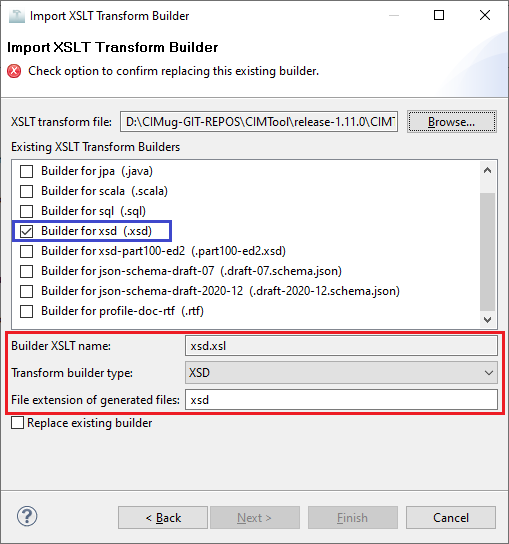
Given this builder ships with CIMTool the below screenshot highlights the existing NTE (Name/Type/Extension) settings for the builder. We strongly recommend that you do not import customized versions of this shipped builder over the original in your local CIMTool installation. Doing so will force regeneration of any existing builder-generated artifacts for projects in your workspace that have this builder enabled.
The recommended best practice is to rename the builder file (from xsd.xsl to custom-xsd.xsl for example) before importing. On import this will be interpreted as a new builder and you will be allowed to enter values in the Type and Extension fields.
NOTE: </br>CIMTool requires that file extensions be unique and will prevent you from entering an extension already assigned to a builder. This is because an artifact’s name is derived by concatenating the base name of the CIMTool
.owlprofile with the file extension assigned to the builder. Therefore, a unique file extension must be assigned to each builder when imported. The file extension for a builder can be modified later from within the “Maintain XSLT Transform Builders” screen.
License
This builder is released under the Apache 2.0 license and was developed under sponsorship of the UCAIug.