


adoc-inline-rdfs-mappings.xsl
This builder currently ships with CIMTool.
Builder Description
The adoc-inline-rdfs-mappings.xsl builder generates documentation for an RDFS profile in AsciiDoc format as content to be included within a larger AsciiDoc document. It is a variant of the adoc-inline-rdfs.xsl builder whose member tables have an additional mapping column: text entered on the “Documentation” tab in CIMTool appears in the mapping column, and the UML and profile descriptions in the description column.
The diagram is included from the <profile>.rdfs-t2b.puml file generated by the puml-rdfs-t2b.xsl builder, so that builder should also be enabled for the profile. For a standalone document use the adoc-article-rdfs-mappings.xsl builder.
Below is an extract generated from a EuropeanExtensions profile, which has no “Documentation” tab content, so the mapping cells are empty:
== EuropeanExtensions Profile Specification
// Settings:
:doctype: inline
...
=== Concrete Classes
[[EuropeanExtensions-BoundaryPoint]]
==== BoundaryPoint (European)
...
===== Native Members
[%header,width="100%",cols="15%,15%,25%,45%a"]
|===
|name |type |description |mapping
|[.extension-prefix]##eu:##[.extension.European]##fromEndIsoCode [0..1]##
|<<EuropeanExtensions-String,String>>
|
The ISO code of the region which the "From" side of the Boundary point belongs to or it is connected to.
The ISO code is a two-character country code as defined by ISO 3166 (http://www.iso.org/iso/country_codes). The length of the string is 2 characters maximum.
|
|[.extension-prefix]##eu:##[.extension.European]##fromEndName [0..1]##
|<<EuropeanExtensions-String,String>>
...
|===
XSLT Version
This builder is XSLT 3.0 compliant.
Release History
| CIMTool Release | Release Date | Changes |
|---|---|---|
| 2.3.0 | 08-Jun-2026 | Added to CIMTool (#24). |
Author
Todd Viegut [@tviegut] on behalf of UCAIug.
Submission Date
01-Apr-2025
Builder NTE Configuration
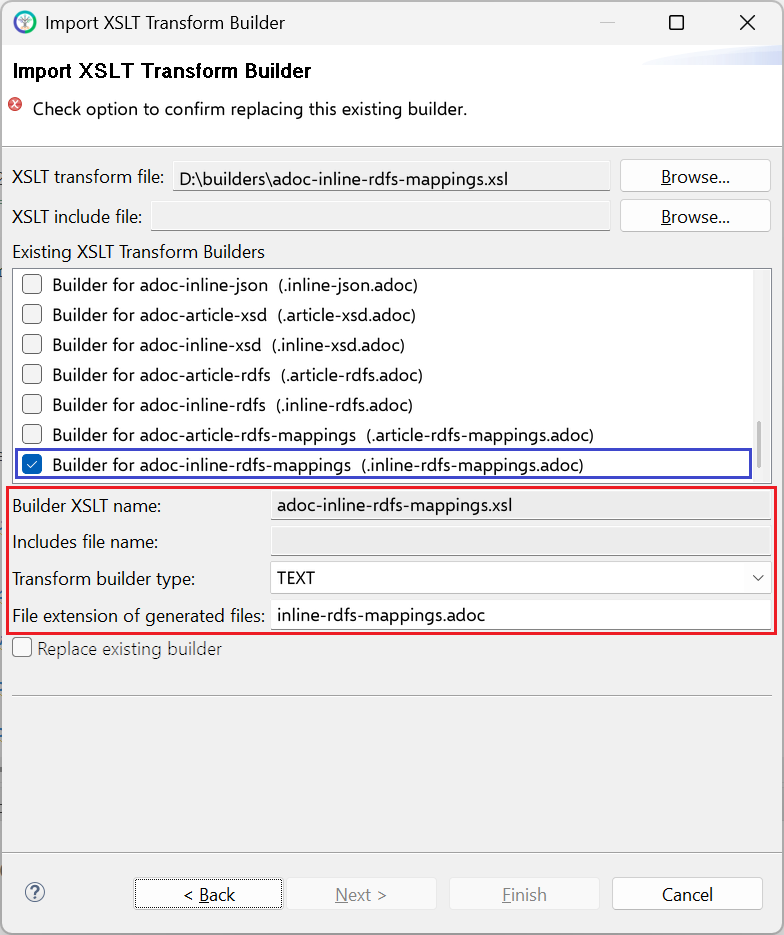
Given this builder ships with CIMTool the below screenshot highlights the existing NTE (Name/Type/Extension) settings for the builder. We strongly recommend that you do not import customized versions of this shipped builder over the original in your local CIMTool installation. Doing so will force regeneration of any existing builder-generated artifacts for projects in your workspace that have this builder enabled.
The recommended best practice is to rename the builder file (from adoc-inline-rdfs-mappings.xsl to custom-adoc-inline-rdfs-mappings.xsl for example) before importing. On import this will be interpreted as a new builder and you will be allowed to enter values in the Type and Extension fields.
NOTE: </br>CIMTool requires that file extensions be unique and will prevent you from entering an extension already assigned to a builder. This is because an artifact’s name is derived by concatenating the base name of the CIMTool
.owlprofile with the file extension assigned to the builder. Therefore, a unique file extension must be assigned to each builder when imported. The file extension for a builder can be modified later from within the “Maintain XSLT Transform Builders” screen.
License
This builder is released under the Apache 2.0 license and was developed under sponsorship of the UCAIug.